Updated: May 2026
Raja Ampat Freediving vs. Scuba Diving: Which is Better?
Deciding between freediving and scuba diving in Raja Ampat depends on your personal goals for underwater exploration. Freediving offers a silent, athletic, and uniquely intimate way to encounter marine life with minimal gear, while scuba diving provides extended bottom time for detailed, prolonged observation of specific reefs and wrecks.
- Wildlife Interaction: Freediving’s silence often allows for closer, more natural encounters with shy megafauna like manta rays and sharks.
- Freedom vs. Time: Scuba allows for up to an hour of continuous immersion; freediving is a series of brief, repeated dives offering unparalleled vertical mobility.
- Logistics: Freediving requires only a mask, fins, and snorkel, enabling access from any vessel; scuba involves heavy equipment and specialized boat support.
The water of the Dampier Strait is a specific, impossible shade of blue, holding the afternoon sun in its upper layers. You slip over the side of the tender, and the immediate silence is the first true sensation. The world above—the drone of the engine, the cries of cockatoos from Gam island—vanishes, replaced by the soft percussion of your own heartbeat. Below, a school of yellow-tailed fusiliers, thousands strong, moves as a single, glittering organism, parting effortlessly around your body. You are not a visitor looking through a window; for a fleeting 90 seconds, you are a part of the seascape. This is the profound choice every underwater explorer faces in the world’s most biodiverse marine ecosystem: how to enter this kingdom. The decision between a tank and a single breath will define everything that follows.
The Silent Intrusion: Encounters with Raja’s Megafauna
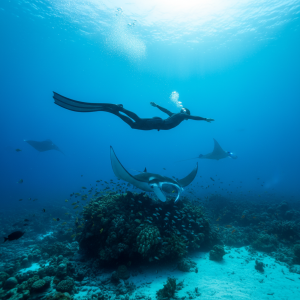
The fundamental difference between the two disciplines reveals itself most profoundly in the presence of Raja Ampat’s celebrated megafauna. I recall a conversation with Andi, a dive guide I’ve known for years who has led trips through these waters for over a decade. We were anchored off Manta Sandy, a famed cleaning station where oceanic manta rays (Manta birostris) congregate. “The scuba divers line up on the bottom, 15 meters down, and they wait,” he explained. “The sound of their bubbles creates a wall. The mantas are used to it, but they keep their distance.” An hour later, he took a small group of us to the same spot with only fins and masks. Instead of descending to the sand, we hovered near the surface, taking turns dropping down silently. The effect was immediate. A 4-meter manta, which had been circling the periphery, broke its pattern and glided directly towards one of our divers, banking only a meter away to show its immense white belly. The encounter was not one of observation, but of interaction. The absence of the constant, mechanical hiss of a regulator changes the dynamic from an intrusion to a curiosity. At sites like Blue Magic or Cape Kri, where sharks and massive schools of trevally are the main draw, this silent approach allows a freediver to slip into the very heart of the action without scattering the participants.
Time vs. Freedom: Deconstructing the Dive Profile
A scuba dive is a structured, horizontal affair. The plan is set: descend to a maximum depth of, say, 25 meters, spend 45 minutes exploring a specific reef contour, and conduct a slow, multi-stop ascent. Your time is finite, limited by the 200 bar of compressed air in the aluminum tank on your back. It is a superb tool for methodical exploration, allowing a photographer the luxury of waiting patiently for a pygmy seahorse to turn just so, or for a marine biologist to conduct a detailed transect. A Raja Ampat freedive session, however, is a vertical and fluid experience. The “bottom time” is measured in seconds, not minutes, but the session itself can last for hours. It’s a series of athletic immersions. You might perform a dozen drops to 15 meters over a vibrant coral garden, each time seeing it from a new angle, playing with the light as the sun moves across the sky. This freedom allows for a totally different kind of exploration. You can follow a turtle from the surface down to the reef, ascend with it as it goes for air, and then descend again. You have access to the entire water column on every single dive, a privilege the scuba diver, bound by slow ascent protocols, does not. This agility is what makes it such a compelling way to experience the dynamic, multi-layered environments of Raja Ampat’s 1,500-plus islands.
The Logistical Footprint: Gear, Boats, and Access
The logistical calculus of exploring a remote archipelago like Raja Ampat shifts dramatically depending on your chosen discipline. The scuba diver is a high-support traveler. The essential kit—BCD, regulators, computer, weights, wetsuit—can easily exceed 20 kilograms before you even add a camera. This necessitates dedicated dive boats with compressors, tank racks, and a crew trained in handling the equipment. It is a proven, effective system for accessing the region’s premier sites, but it carries a significant footprint. Freediving, in its purest form, is elemental. A low-volume mask, a pair of long fins, and a weight belt are all that’s required. A full, high-end kit might cost $800, compared to the $2,500 or more for a mid-range scuba setup. This minimalism translates into unparalleled access. While the scuba liveaboard moors in a deep channel, a freediver can take a sea kayak or paddleboard to explore the shallow lagoons and mangrove forests that are inaccessible to larger vessels. I’ve spent entire afternoons exploring the reef systems fringing the private karst islets of Misool with nothing more than what I could fit in a small dry bag. This simplicity is, for many, the ultimate luxury—the ability to shed the infrastructure and forge a more direct connection with the environment. It is the core of the Raja Ampat freediving philosophy.
Exploring the Topography: Where Each Discipline Shines
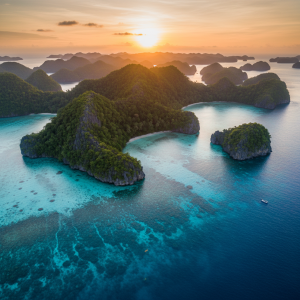
Raja Ampat’s underwater topography is not monolithic; it’s a complex tapestry of deep walls, shallow gardens, rushing channels, and serene mangroves. Each environment lends itself better to one discipline over the other. Scuba diving is the undisputed champion for exploring the region’s deeper features. Consider the P-47 Thunderbolt, an American WWII fighter plane resting on a sandy bottom at 30 meters off the coast of Wai Island. Properly exploring this historic wreck requires more time at depth than any single breath-hold can provide. Similarly, the world-renowned site known as “The Passage,” a narrow, river-like channel between Gam and Waigeo islands, is a drift dive where the current carries you past spectacular soft coral-draped walls. Managing this environment is far safer and more practical with a steady air supply. Freediving, however, finds its paradise in the top 15 meters of the water column, which is precisely where Raja Ampat hosts its most explosive biodiversity. The area lies at the heart of the Coral Triangle, an area containing 76% of the world’s coral species. The incredible hard coral gardens of the Fam Islands, or the pristine reefs around the Wayag archipelago, often rise to within just a few meters of the surface. Here, a freediver can spend hours dipping into a kaleidoscopic world of color and life, a world that a scuba diver, concerned with their safety stop, might only glimpse on their way back to the boat. Our guided Raja Ampat freedive trips are specifically designed to maximize time in these vibrant, light-filled shallows.
The Physical and Mental Game: Training and Philosophy
Beyond the gear and the location, the two disciplines are fundamentally different states of mind. Scuba diving is an exercise in external awareness. The diver’s attention is focused outward: on their buddy, their depth gauge, their remaining air pressure, and the environment they are observing. It is a technical skill that, once mastered, allows the mind to become a passive recorder of the underwater world. Freediving is almost the inverse; it is a discipline of internal awareness. The journey begins before you even leave the surface, with a period of calm, focused breathing designed to lower the heart rate and quiet the mind. The dive itself is an act of profound physiological control, intentionally triggering the mammalian dive reflex—a series of adaptations, including a dramatic slowing of the heart known as bradycardia, that allows the body to conserve oxygen. A trained freediver can reduce their heart rate to below 30 beats per minute. This internal focus creates a “flow state” where the distinction between self and environment begins to blur. You are no longer just looking at the reef; you are moving through it with an animal’s grace, powered by your own biology. It is less a sport and more a form of aquatic meditation, demanding a deep trust in your body’s innate capabilities.
Quick FAQ: Your Raja Ampat Diving Questions Answered
Do I need to be a super-athlete to freedive in Raja Ampat?
Absolutely not. While professional freedivers achieve incredible depths, the true beauty of recreational freediving in Raja Ampat is accessibility. The most vibrant sections of reef are found between 5 and 15 meters. A basic certification course, such as an AIDA 2 or PADI Freediver, focuses on safety, technique, and breath-hold skills that make this range comfortable and achievable for anyone with a reasonable level of fitness.
Can scuba divers and freedivers be on the same boat?
Yes, this is increasingly common and an ideal way for groups with mixed interests to explore the area. Premier liveaboards and resorts throughout Raja Ampat now cater to both. A typical day might see the scuba divers dropped at one end of a reef to begin their drift, while the freedivers work the upper reef slope from a dedicated tender, meeting back at the boat an hour later.
What’s the best time of year for diving in Raja Ampat?
The primary dive season runs from October through April. During these months, the seas are at their calmest, and underwater visibility frequently exceeds 30 meters. This period avoids the strongest winds and rains of the southeast monsoon. For more general travel advice, the official indonesia.travel portal is an excellent resource for planning logistics.
Is Raja Ampat a protected area?
Yes, and this is crucial to its ecological integrity. The entire region is a network of Marine Protected Areas (MPAs). All visitors are required to purchase a marine park permit tag, which costs IDR 700,000 (about $45 USD) for international visitors and is valid for one year. These funds are vital for supporting conservation patrols and community programs. The area’s immense value is recognized globally, and it is on the tentative list for inscription as a UNESCO World Heritage Site.
Ultimately, the question is not which discipline is empirically “better,” but which language you wish to speak underwater. Do you prefer the extended, descriptive prose of a scuba dive, with its patient observation and wealth of detail? Or are you drawn to the spare, intense poetry of a raja ampat freedive, a silent conversation between your own body and the heart of the ocean? There is no wrong answer, only a personal preference. For those who seek that silent, weightless dance, who wish to become part of the seascape rather than just a spectator, the experience is transformative. The Raja Ampat Freedive Society was founded on this principle—crafting bespoke journeys that immerse you in the world’s last great marine wilderness, one perfect breath at a time.