Updated: May 2026
How to Choose a Reputable Raja Ampat Freediving Operator
- Verify their instructors’ credentials and emergency medical training.
- Assess their itineraries for tidal awareness and crowd avoidance strategies.
- Confirm they actively support local communities and conservation initiatives.
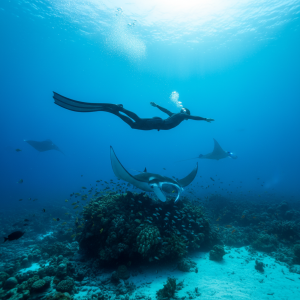
The water is a shade of blue that exists nowhere else on Earth, a liquid turquoise that seems to generate its own light. You take your final breath-up, the warm Papuan air filling your lungs, and duck-dive. Silence descends, absolute and profound, broken only by the sound of your own heartbeat. Below, a universe of life unfolds. A school of yellowtail fusiliers, thousands strong, parts around you like a living curtain. A manta ray, with a wingspan of four meters, glides effortlessly in the deep. This is the singular experience of a raja ampat freedive, a communion with the planet’s most vibrant marine ecosystem. But this transcendent moment is not a matter of chance; it is the direct result of the meticulous planning, safety, and local expertise provided by your operator. Choosing the right one is the single most important decision you will make.
Beyond the Brochure: Scrutinizing Certifications and Safety Protocols
In the remote waters of West Papua, more than 1,500 kilometers from the nearest major hospital in Jakarta, safety is not a luxury—it is the absolute foundation of any reputable operation. Any operator worth their salt will lead with their safety credentials, not bury them. The first line of inquiry should be instructor certification. Look for active, in-status instructors certified by globally recognized agencies like AIDA, PADI Freediver, or Molchanovs. Don’t just take their word for it; ask for certification numbers. A confident operator will provide them without hesitation. I recently spoke with a leading safety officer for a luxury liveaboard fleet, and he was blunt: “If a potential client can’t easily verify my team’s credentials, I’ve already failed them.”
Beyond instructor qualifications, examine their on-board medical equipment and emergency action plan (EAP). A non-negotiable minimum is a comprehensive first aid kit, pure oxygen administration sets, and an automated external defibrillator (AED). Ask pointed questions. What is the EAP for a potential blackout or lung squeeze? How often do they run drills? Do they have a satellite phone and a reliable, tested contact for medical evacuation services like DAN (Divers Alert Network)? A top-tier operator will have these procedures documented and will be able to walk you through them. The ideal instructor-to-diver ratio for in-water training or exploration should be no more than 1:3. Anything higher, especially in variable conditions, compromises personalized safety monitoring. This isn’t just about ticking boxes; it’s about fostering a culture of safety that allows you to relax and fully immerse yourself in the profound beauty of the dives.
The Liveaboard vs. Resort-Based Operator Dilemma
Your choice of operator model—a sea-faring liveaboard or a land-based resort—will fundamentally shape your Raja Ampat experience. Neither is inherently better, but they offer vastly different approaches to exploring this archipelago of over 1,500 islands. The liveaboard is the classic choice for comprehensive exploration. These vessels, often traditional Indonesian Phinisi schooners ranging from 30 to 40 meters in length, grant access to the vast, disparate corners of the region. A typical 10-night itinerary might take you from the current-swept passages of the Dampier Strait to the otherworldly limestone karsts of Wayag in the north, and then south to the untouched reefs of Misool. This is the only practical way to experience the full spectrum of Raja Ampat’s biodiversity. The advantage is variety; you might dive five or six distinct world-class sites in a single day. The trade-off is a life dictated by the boat’s schedule. A high-end liveaboard will cost between $6,000 and $9,000 per person for a 10-day trip, but this typically includes all diving, meals, and park permits.
Conversely, a resort-based operator offers depth over breadth. By staying at a single location, like the acclaimed Misool Eco Resort or a private island retreat near Kri, you develop an intimate connection with a specific set of reefs. You can dive the same site at different times of day, observing how the marine life changes with the tides. Resorts offer more flexibility and non-diving amenities. They are an excellent option for couples or groups with varying interests. The best resorts have exceptional “house reefs” just steps from your bungalow, allowing for spontaneous freedives whenever you wish. The key is to ensure the resort’s dive center is not an afterthought but a dedicated, professionally run operation with its own fleet of well-maintained day boats to explore the surrounding area. According to Indonesia’s official tourism portal, this dual approach allows the region to cater to different travel styles while managing tourism impact.
Evaluating Local Knowledge and Itinerary Design
The true mark of an elite operator lies not in their boat or their marketing, but in the nuanced, almost telepathic understanding their guides have of the local waters. Raja Ampat’s currents are legendary; in channels like the Dampier Strait, they can reach speeds of over six knots. An inexperienced guide sees this as a hazard; a seasoned Papuan guide sees it as an engine, a conveyor belt that concentrates nutrients and attracts megafauna. A reputable operator’s itinerary isn’t a fixed document; it’s a fluid plan that adapts daily to tides, weather, and swell. Ask a potential operator how they plan their dives. Do they use tide charts? Do they have years of personal experience in these specific channels? The difference is palpable: one boat might arrive at the famed “Blue Magic” pinnacle to find a raging, undiveable current, while a smarter operator arrives an hour later at slack tide to find a placid, fish-filled paradise.
This expertise extends to managing the human element. As Raja Ampat’s popularity has grown, certain sites like Manta Sandy or Melissa’s Garden can become crowded. A superior guide knows the schedules of the other boats. Their goal is to get you in the water 30 minutes before everyone else arrives, granting you a private audience with the mantas or an uninterrupted view of the endless coral fields. This insider knowledge is priceless. It requires deep relationships within the local community and years of on-the-ground experience. The best Raja Ampat freediving experiences are defined by these moments of solitude and wonder, which are only possible through an operator who prioritizes intelligent, adaptive itinerary design over a rigid, check-the-box approach.
Conservation Commitment: A Litmus Test for Quality
Raja Ampat is the global epicenter of marine biodiversity. Located at the heart of the Coral Triangle, its waters are home to nearly 600 species of reef-building coral—75% of the world’s known total—and over 1,700 species of fish. Its significance is so profound that it is on UNESCO’s Tentative List for World Heritage status. To visit this place is a privilege, and with that comes a responsibility. A truly reputable operator understands this implicitly; they are not just tour providers but active guardians of the ecosystem. Their commitment to conservation should be tangible, transparent, and woven into the fabric of their operations.
Look for operators who go beyond the bare minimum. Do they employ local Papuan guides and crew, providing sustainable livelihoods that create an economic incentive for conservation? Do they contribute a portion of their revenue to established local NGOs like the Misool Foundation or the Raja Ampat Marine Park authority? Ask about their operational practices. Do they have a strict no-touch, no-take policy? Do they use mooring buoys instead of dropping anchors that can shatter decades-old coral colonies? Do they actively participate in reef clean-ups or data collection for scientific bodies? The mandatory Raja Ampat Marine Park permit, which costs IDR 1,000,000 (about $65 USD) for foreign visitors, is a start, but leading operators see this as a baseline, not the extent of their contribution. Our philosophy at the Raja Ampat Freedive Society is built on this principle of stewardship. Choosing an operator with a demonstrated conservation ethic ensures that your investment supports the long-term health of the reefs you’ve traveled so far to see.
The Vessel and The Crew: Your Home on the Water
When you embark on a liveaboard journey, the vessel is more than just transportation; it is your home, your restaurant, and your dive center for the duration of your trip. The quality of the boat and its crew can make or break the experience. While the romantic image of the traditional Phinisi schooner is alluring, it’s crucial to look past the sails and inspect the substance. Ask for recent photos of the cabins, the dive deck, and the common areas. Inquire about maintenance schedules, particularly for the engines and compressors. A friend who captains a charter yacht in these waters for over 20 years told me, “A well-maintained engine room is the clearest sign of a professional operation.”
Equally important is the crew. A high-end liveaboard often has a crew-to-guest ratio approaching 1:1. This ensures impeccable service, from the chef who prepares multi-course meals to the tender drivers who skillfully retrieve you after each dive. The dive guides are the lynchpin. They should not only be certified and experienced but also passionate educators who can identify obscure macro critters and explain complex animal behaviors. The captain’s experience is paramount; navigating the reef-strewn waters of Raja Ampat requires thousands of hours of local knowledge. The quality of the dive tenders, or skiffs, is another detail that signals a top-tier operator. They should be spacious, stable, and equipped with sturdy ladders for easy re-entry. These seemingly small details collectively create an environment of comfort, safety, and seamless luxury, allowing you to focus entirely on the incredible underwater world.
Quick FAQ on Choosing a Raja Ampat Freediving Operator
What is the typical cost for a reputable Raja Ampat freediving liveaboard?
For a premium, all-inclusive liveaboard experience on a well-appointed vessel, you should budget between $500 and $900 USD per person, per night. This usually covers accommodation, all meals, diving, and park permits, but excludes flights and equipment rental.
Do I need to be an advanced freediver to join a trip?
Not necessarily. Most high-quality operators cater to a range of skill levels. However, you must hold a basic freediving certification (e.g., AIDA 2, PADI Freediver). It is critical to communicate your experience level beforehand to ensure they can provide appropriate supervision and choose dive sites suitable for your depth capabilities.
When is the best season to go freediving in Raja Ampat?
The primary diving season runs from October through April. During these months, the seas are generally calmer, and underwater visibility is at its peak, often exceeding 30 meters. The shoulder months can also offer excellent conditions with fewer boats in the water.
How is the Marine Park permit handled?
Your operator should handle the acquisition of your Raja Ampat Marine Park permit (known as the KJL). The fee is currently IDR 1,000,000 for international visitors and is valid for 12 months. The operator will typically collect this fee from you and process the payment on your behalf, providing you with the required tag.
Choosing your operator is the critical first step in a journey to the planet’s last true paradise. It’s an investment not just in a vacation, but in an experience that will resonate long after you have dried off. The right guide doesn’t just show you the reef; they reveal its secrets, protect its integrity, and ensure you do so in the utmost safety and comfort. At the Raja Ampat Freedive Society, we have built our reputation by vetting partners against these exact demanding criteria. To begin planning your own journey, explore our curated raja ampat freedive expeditions and connect with operators who share our commitment to excellence.