Updated: May 2026
Best Time to Freedive Raja Ampat — Month-by-Month Water, Weather & Manta Guide
Raja Ampat Freedive is a curated Indonesia luxury tourism experience offered by Raja Ampat Freedive Society: handpicked routes, vetted operators, transparent pricing, and 24/7 concierge support across Indonesia.
- What makes Raja Ampat Freedive a premium experience.
- How Raja Ampat Freedive Society curates exclusive access and concierge logistics.
- Routes, seasons, and pricing transparency — no hidden fees.
When to come — Raja Ampat freediving month by month.
Visibility, water temperature, current strength, manta seasonality, monsoon pattern. The honest seasonal map for choosing your voyage window.
The two-monsoon system
Raja Ampat sits south of the equator at the western tip of New Guinea — see Wikipedia for geographic context. The region experiences two seasonal monsoons. The north-west monsoon (October-March) brings calm seas, light winds, and the best freediving conditions. The south-east monsoon (May-September) brings stronger winds and choppier surface conditions. April and October are transitional months. Our voyage calendar concentrates departures in the October-March window for this reason.
October — early peak season
October opens the voyage season. Wind dies, sea calms, water clarity returns to 25-30m at most sites. Water temperature 28-29°C. Mantas begin gathering at Manta Sandy and Manta Ridge. Currents are moderate — Cape Kri runs 1-1.5 knots, manageable for AIDA-2 freedivers. October is one of our top three months. Our first 2026 voyage runs October 18-25.
November — solid peak
November is among the most reliable months for clean water, calm seas, and manta encounters. Water temperature 28-29°C. Visibility 25-35m at best sites. Manta aggregations build. Soft coral spawning events occur (variable, location-dependent). Currents moderate. November bookings tend to fill 4-5 months out.
December – January — manta peak
December and January are our most-requested months. Manta Sandy density peaks (40-80 individuals on the cleaning station some days). Visibility excellent. Water temperature 28-29°C. Some afternoon thunderstorms possible (north-west monsoon brings periodic squalls); rarely affects diving. Soft coral colours saturated. Our January 2026 voyage runs January 17-24 — typically books out 6 months ahead.
February — quieter excellence
February is sometimes underbooked but offers near-identical conditions to January with fewer guest boats in the water. The Coral Triangle weather pattern continues calm. Manta presence still strong. We run targeted February charters by request (typically AIDA instructor candidate groups).
March — late peak
March closes the peak season. Conditions excellent through mid-March; second half of March can show early monsoon-transition wind. Manta presence still solid. Our March 2026 voyage runs March 14-21, deliberately scheduled to capture late-peak conditions before the seasonal transition.
April — transitional caution
April is the first transitional month. Conditions remain fishable but variability increases. South-east monsoon influence begins on Misool’s southern exposure. We typically don’t schedule confirmed voyages in April; we accept private charter requests with the explicit understanding that itineraries may need to flex around weather.
May – September — south-east monsoon
The south-east monsoon dominates May through September. Stronger surface winds (15-25 knots common), choppier seas, reduced visibility on Misool’s southern exposure, occasional rain. Dampier Strait remains divable; Misool karst less so. We don’t run the standard 7-day Dampier+Misool voyage in this window. We run a 5-day Dampier-only voyage on request for serious freedive groups willing to accept the more constrained itinerary. Water temperature drops slightly to 27-28°C.
Manta seasonality — the critical detail
Manta Sandy and Manta Ridge are not year-round aggregations. The reef mantas (Mobula alfredi) congregate in greatest numbers October-April. Peak density December-February. We cannot guarantee manta encounters, but during the peak window 95%+ of our guest-days produce at least one manta encounter, often multiple.
What to wear — wetsuit and exposure
28-29°C water year-round means a 3mm shorty or full-suit is sufficient for most freedivers. Long-sessions (90+ minutes) some guests prefer 5mm full-suit for extended thermal comfort. Hooded vest under 3mm full-suit is the apnea-instructor preference. We loan 3mm full-suits aboard but most guests bring their own.
Choose your month
For first-time Raja Ampat freedivers we recommend November through February — most reliable conditions, peak manta. For photographers seeking quietest manta cleaning station behaviour, late January through February. For serious depth training, March (calm, water clarity, fewer guests). For our flexible schedule of three confirmed 2026 voyages, see the 7-day voyage briefing. For specific Misool site detail, our Misool spots briefing.
Pick your window
October-March 2026 confirmed voyages. Charter dates by request.
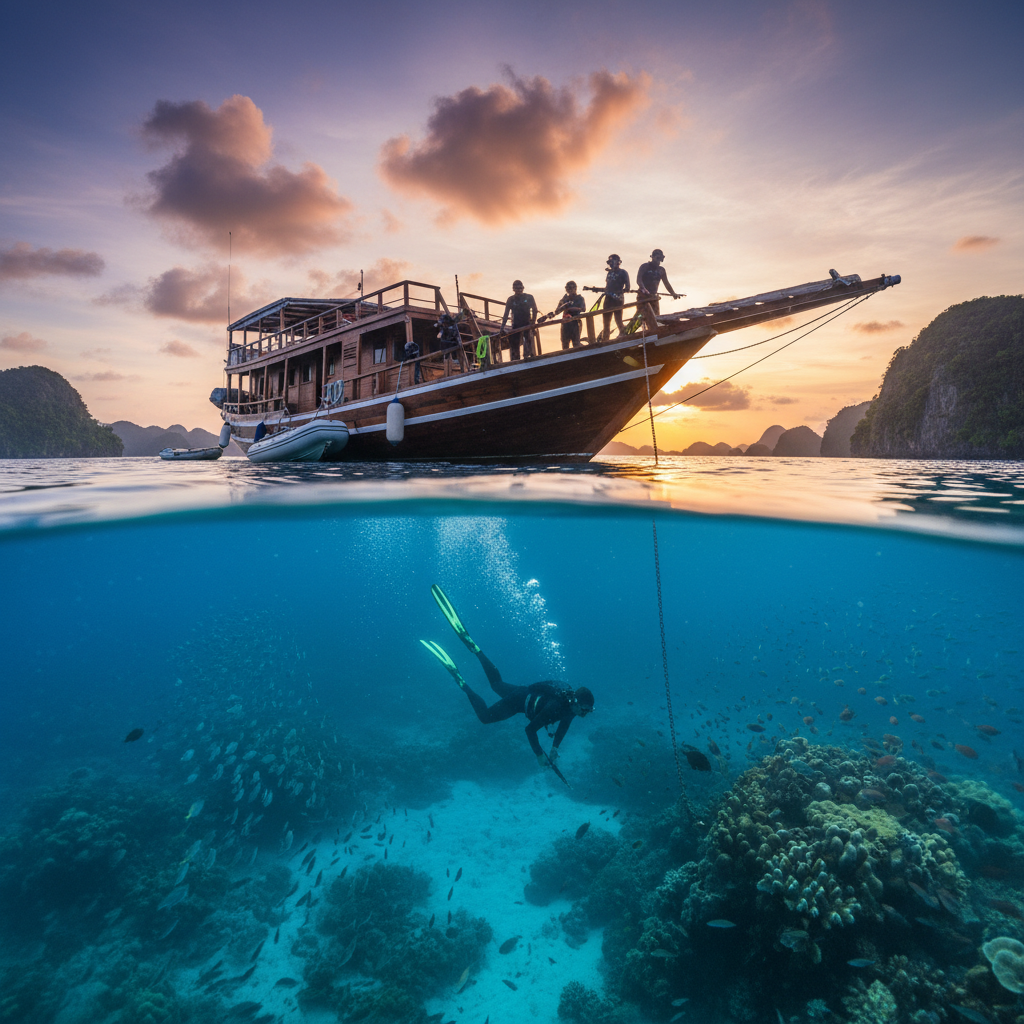
Imagine the world falling silent around you as you descend into an aquatic cathedral, sunlight dappling through turquoise waters onto pristine coral spires. This is the unparalleled sensation of a Raja Ampat freedive, an experience that transcends mere sport to become a profound connection with one of Earth’s most vibrant ecosystems.
Exploring Raja Ampat’s underwater architecture
While the surface may hint at a scattering of emerald islands, the true majesty of Raja Ampat reveals itself beneath the waves. Here, volcanic activity and tectonic shifts have sculpted an underwater landscape of unparalleled diversity, making every freedive a journey through a unique geological artwork. Think dramatic drop-offs plunging hundreds of meters into the abyss, vibrant coral gardens flourishing on sun-drenched plateaus, and intricate caverns that invite exploration. These formations create dynamic currents and sheltered pockets, offering a variety of freediving conditions from challenging deep wall dives to serene shallow explorations perfect for honing technique. The average water temperature here consistently hovers around a comfortable 28-30°C (82-86°F), allowing for extended bottom time and a truly immersive experience.
The sheer scale of this underwater architecture is staggering. Raja Ampat is part of the Coral Triangle, often referred to as the Amazon of the seas, boasting the highest marine biodiversity on the planet. Its reefs are home to over 1,500 species of fish and an astounding 75% of the world’s known coral species, making each descent a visual feast. Freedivers can glide past massive gorgonian fans, explore intricate bommies teeming with life, or navigate through schools of fusiliers that swirl like living clouds. This unique topography not only supports an incredible array of life but also provides endless opportunities for breath-hold exploration, from shallow reef photography to challenging deep dives along ancient volcanic walls.
Beyond the iconic mantas: A symphony of marine life
While the majestic manta rays are undoubtedly a highlight of any Raja Ampat freedive, the archipelago offers a much broader spectrum of encounters that will captivate even the most seasoned underwater explorer. Beyond the graceful giants, you’ll find yourself amidst a vibrant tapestry of marine creatures. Keep an eye out for the endemic wobbegong shark, a fascinating bottom-dweller perfectly camouflaged against the coral, or the elusive pygmy seahorse, a master of disguise no bigger than a fingernail. Schools of barracuda, jacks, and trevally frequently patrol the reef edges, creating spectacular swirling formations that envelop freedivers in a living current.
The pristine waters also host six of the world’s seven species of sea turtles, including green, hawksbill, and leatherback turtles, often spotted gliding gracefully through the water or resting on coral ledges. For those with a keen eye, the macro life is equally captivating, with nudibranchs, vibrant anemonefish, and countless other invertebrates adding splashes of color to every crevice. This incredible biodiversity is a testament to Raja Ampat’s protected status and its remoteness, offering a rare opportunity for truly unspoiled interactions. The region’s commitment to conservation, often supported by luxury tourism operators, helps ensure these wonders remain for generations to come. For more on the region’s natural heritage, explore its rich biodiversity on Indonesia.travel.
Conscious freediving in a pristine sanctuary
A Raja Ampat freedive is more than just an adventure; it’s an immersion into one of the planet’s most vital marine sanctuaries. The archipelago is designated as a Marine Protected Area (MPA) covering approximately 4.6 million hectares, a testament to its ecological significance and the concerted efforts to preserve its unparalleled biodiversity. For the discerning traveler, this means not only breathtaking encounters but also the peace of mind that comes from engaging with responsible tourism. Operators like Raja Ampat Freedive Society are committed to sustainable practices, working closely with local communities to minimize environmental impact and support conservation initiatives.
Choosing a luxury freediving experience in Raja Ampat often means contributing directly to these vital preservation efforts. Many operators engage in coral restoration projects, support local ranger patrols, and educate visitors on respectful interaction with marine life. This commitment ensures that your freedive journey is not just a personal triumph but also a positive force for the future of this extraordinary ecosystem. It’s an opportunity to connect deeply with nature, understanding that your presence supports the very beauty you are privileged to witness, ensuring Raja Ampat remains a sanctuary for both marine life and future freedivers.


