Updated: May 2026
Raja Ampat Freedive — Raja Ampat Freediving vs SCUBA — Honest…
Raja Ampat Freedive is a curated Indonesia luxury tourism experience offered by Raja Ampat Freedive Society: handpicked routes, vetted operators, transparent pricing, and 24/7 concierge support across Indonesia.
- What makes Raja Ampat Freedive a premium experience.
- How Raja Ampat Freedive Society curates exclusive access and concierge logistics.
- Routes, seasons, and pricing transparency — no hidden fees.
Freediving vs SCUBA in Raja Ampat — honest trade-offs.
Both are valid ways to experience the world’s most biodiverse marine ecosystem. Here is the practical comparison: depth, encounters, photography, cost, and which apneist or diver each suits.
Why this question keeps coming up
Most ocean travellers arrive at Raja Ampat with a SCUBA mindset because that is how the region is marketed in international dive media. SCUBA liveaboards have run from Sorong since the late 1990s; freediving voyages only since around 2015. So the question we are asked, almost weekly, is: “Should I bring SCUBA or freedive Raja Ampat?” The answer depends on what you specifically want from the ocean here. Below is the honest comparison.
Depth profile — where Raja Ampat reefs actually live
Raja Ampat reef tops sit predominantly at 3-15m. Mantas at Manta Sandy clean at 8m. Soft coral gardens at Boo Rocks summit at 5m. Wedding Cake’s pillar tops at 4m. The walls drop deeper (Cape Kri to 25m, Misool walls to 30m+) but the most colour-saturated, fish-densest reef is shallow. SCUBA bottom time at 5m is functionally unlimited (you’d run out of air before nitrogen mattered), but at 5m you’re not significantly more capable than a freediver who returns every 90 seconds. Freedivers do 8-12 descents over the same coral garden a SCUBA diver crosses once. The freediver gets repeated chances at a behaviour photograph. The SCUBA diver gets a single-pass survey.
Encounters — manta, shark, behavioural
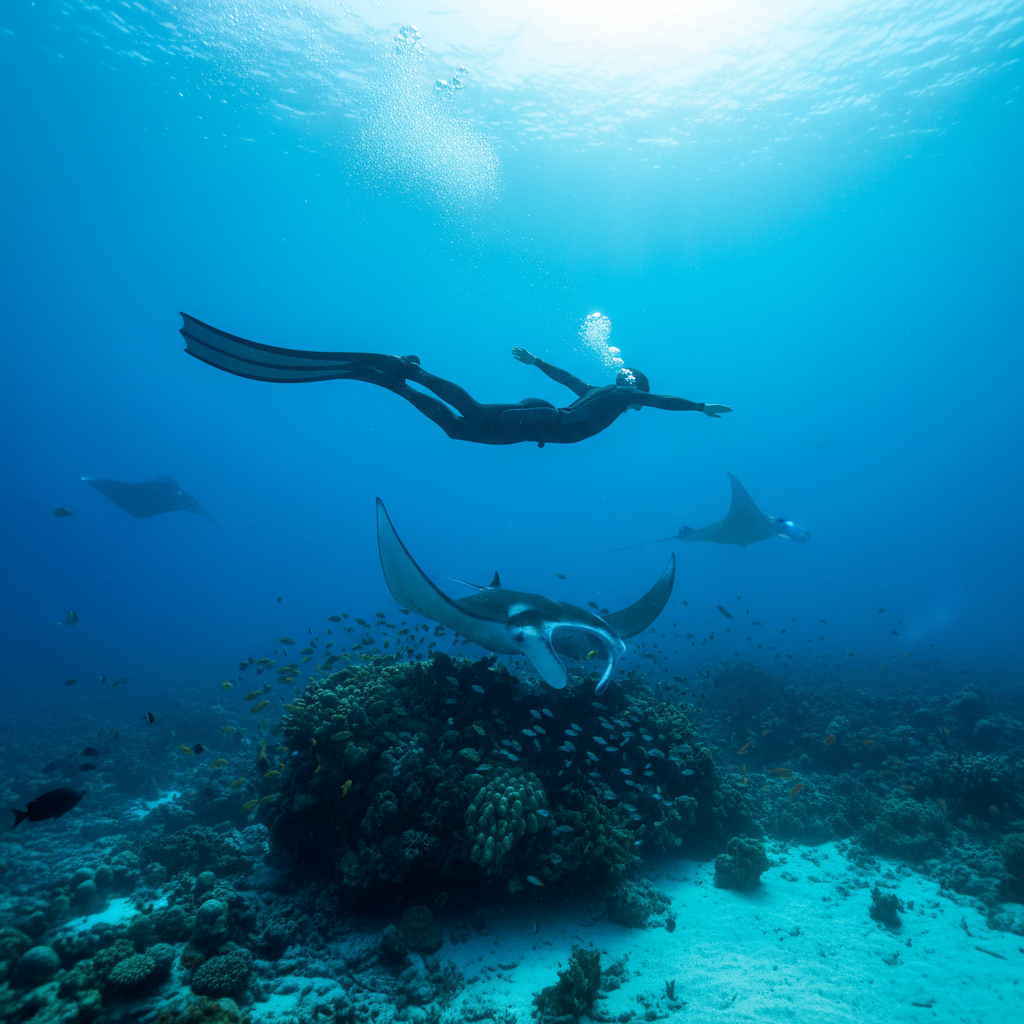
This is where freediving has the clearest advantage. Mantas (Mobula alfredi) at Manta Sandy approach freedivers more closely than SCUBA divers. The compressed-air bubble noise from a SCUBA regulator carries through water and triggers manta avoidance behaviour. Multiple academic studies on manta cleaning station behaviour confirm this — see Coral Triangle Initiative research outputs. The same applies to wobbegong sharks (silent approach lets them stay sleeping), reef sharks (curious to silent freedivers, evasive of bubbles), and bumphead parrotfish at sunrise. Photographers who shoot manta close-up portraits invariably go freediving.
Photography — natural light reach
Sun penetration to 5m at the equator is exceptional. Freediving photography uses natural light at the colour-saturated shallow reef. SCUBA photography typically uses strobes at depth (necessary because red wavelengths are absorbed by 10m). Both approaches produce world-class images, but they produce different images. Freediving photo style: sun-rays, surface-light caustics, freediver-as-subject silhouettes. SCUBA photo style: macro detail, strobe-lit fish portraits, deep wall scenes. If your portfolio leans toward sun-light freediver imagery, choose freediving. If you want pygmy seahorse macro at 25m, choose SCUBA.
Physical demand — opposite stress profiles
Freediving stress is anaerobic and respiratory — your CO₂ tolerance, equalisation comfort, and breath-up routine matter. SCUBA stress is mainly equalisation and gear management. Most physically prepared people find freediving more demanding mentally (the breath-hold discipline) and SCUBA more demanding physically over a full week (gear weight, multi-dive nitrogen loading). Freediving has zero decompression risk. SCUBA on a liveaboard with 4 dives per day is approaching technical territory and requires conservative dive profile management.
Certification and learning curve
For Raja Ampat-grade freediving you need AIDA-2 or equivalent — typically a 2-3 day course, 16m dynamic depth, 1:30 static breath-hold, knowledge of safety and rescue. SCUBA Open Water (PADI/SSI) is similar: 3-4 days, certifies to 18m. Either certification is achievable in Sorong before our voyage if you arrive a week early. We run a 3-day Sorong AIDA-1 to AIDA-2 foundation course for guests new to apnea. Read our certification path briefing for the AIDA-2 to AIDA-instructor progression.
Cost — surprisingly comparable
A 7-day Raja Ampat SCUBA liveaboard typically runs $3,500-6,000 per person depending on Phinisi class. Our 7-day freediving voyage at the equivalent Phinisi class runs $2,950-5,950. The freediving voyage is generally 10-15% lower cost because we don’t carry compressor, tanks, regulators, dive computers fleet, or the additional crew (typically two dive guides plus a compressor operator on SCUBA boats). Marine Park entry fee, transfers, food, and base operating costs are equivalent.
Which suits you
Choose freediving if: you photograph behaviour or want close manta encounters, you want a quieter voyage rhythm with apnea yoga and mental discipline, you have or want AIDA-2 certification, you appreciate the silent approach. Choose SCUBA if: you want extended bottom time at 20-30m, you prioritize macro photography, you have logged 50+ dives already and are not interested in apnea, you want to maximize species count over a single dive. Many of our repeat guests do one SCUBA voyage and one freediving voyage in successive years. Both are valid. We chose to specialize in apnea and run only freediving expeditions.
More reading
For specific freedive site briefings, see Misool spots field guide. For when to come, our month-by-month seasonal guide. For the full voyage detail, the 7-day Coral Triangle apnea voyage briefing.
Choose freediving
Six freedivers per voyage. Three confirmed 2026 departures.
The silent immersion: why freediving elevates the Raja Ampat experience
Imagine the soft current barely stirring your hair as a manta ray glides effortlessly just feet away, its immense shadow momentarily eclipsing the sun-dappled coral. There is an undeniable magic to exploring Raja Ampat’s underwater realm on a single breath. Unlike the rhythmic exhalations of SCUBA gear, freediving offers an unparalleled silence, allowing you to truly become one with the environment. This profound quiet cultivates a deeper connection, enabling you to observe marine life in their most natural state, often drawing curious reef sharks or schools of fusiliers closer than you might anticipate. Without the distraction of bubbles or bulky equipment, the focus shifts entirely to the vibrant tapestry of life unfolding before your eyes.
This minimalist approach is, in itself, a form of luxury. It grants access to shallower, pristine reefs and hidden pinnacles that might be overlooked by traditional divers, offering an intimate perspective on some of the world’s most untouched ecosystems. The absence of heavy gear also means greater agility, allowing you to gently navigate intricate coral gardens and explore submerged caves with an effortless grace, fostering a sense of freedom that is both exhilarating and deeply meditative.
Unveiling Raja Ampat’s underwater tapestry through a single breath
Raja Ampat is globally celebrated as the epicenter of marine biodiversity, a title it proudly wears. Freediving here allows for an unfiltered appreciation of this staggering variety. From the kaleidoscopic hues of soft corals swaying in the currents to the intricate structures of hard coral formations, every dive unveils a new masterpiece. You might encounter majestic green sea turtles gliding past, observe blacktip reef sharks patrolling their territories, or witness the mesmerizing dance of schooling barracuda, all within the breathtaking clarity that often exceeds 30 meters of visibility.
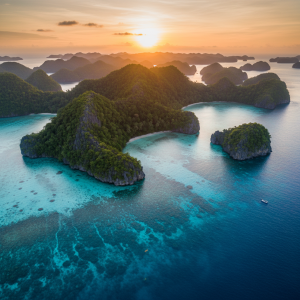
The region is part of the Coral Triangle, home to an astonishing 75% of the world’s coral species and over 1,500 species of fish, making every descent an encounter with unparalleled natural abundance. This rich ecosystem thrives in relatively shallow waters, making it perfectly suited for freedivers who wish to spend extended periods observing intricate macro life and larger pelagics alike. The unique geological formations, including dramatic limestone karsts, also extend below the surface, creating a varied underwater landscape ripe for exploration.
Crafting your bespoke freedive journey in the heart of biodiversity
For the discerning traveler, a Raja Ampat freedive experience extends beyond the underwater moments; it encompasses a meticulously crafted journey. Luxury in this context means personalized itineraries tailored to your skill level and preferences, guided by world-class freediving instructors and local experts who know the quietest coves and the most vibrant reefs. Imagine private charters navigating the archipelago’s myriad islands, leading you to secret spots where untouched beauty awaits, far from the well-trodden paths.
This bespoke approach ensures seamless logistics, from private transfers between remote island resorts and liveaboards to gourmet dining prepared with fresh, local ingredients. Emphasizing sustainable practices, these luxury freedive journeys also contribute directly to the conservation of Raja Ampat’s fragile ecosystem, ensuring that your extraordinary encounters are both memorable and responsible. It is an invitation to engage with nature on its own terms, facilitated by an unmatched level of comfort and expertise, creating a truly transformative travel experience.